
What Is a Purchase Order Number on an Invoice?
A client has asked you to put a PO number on your invoice - but what does that mean? This guide explains what purchase order numbers are, who supplies them, where to put them, and why missing one can delay payment.
You finish a piece of work, create the invoice and send it to your client.
Then the reply arrives:
“Thanks - could you resend this with the PO number?”
If you mainly work with individuals or small businesses, you may never have come across a purchase order number before.
But once you start invoicing larger companies, agencies, public-sector organisations or businesses with a dedicated finance team, purchase orders become much more common.
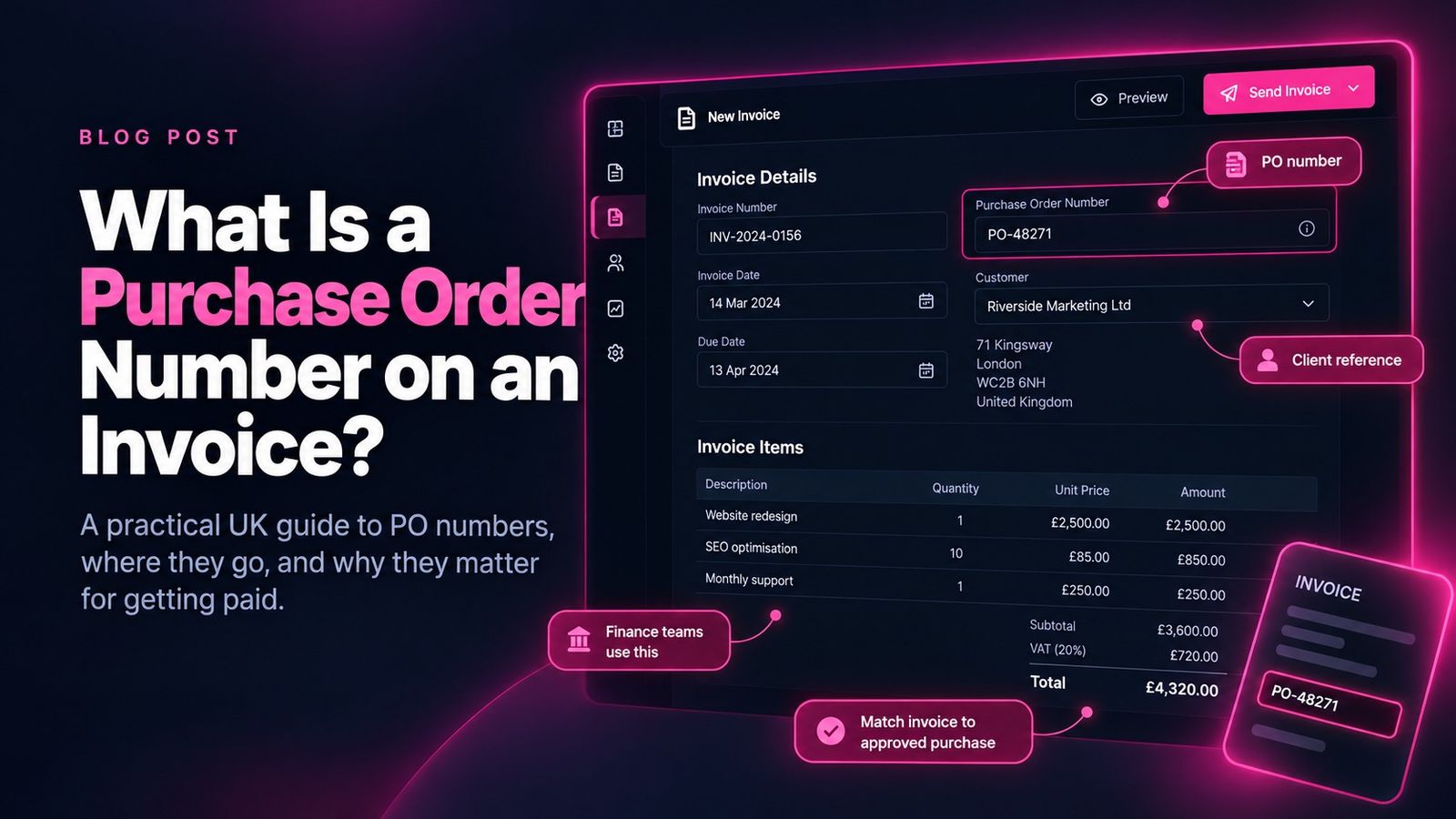
A purchase order number, often shortened to PO number, is a reference created by your customer to identify and authorise a purchase.
If your customer has given you one, they may expect it to appear on your invoice so their accounts team can match your bill to the purchase they previously approved.
That little reference can make a surprisingly big difference to how quickly your invoice makes it through their payment process.
This guide is designed to help with the practical side of invoicing. recevo.io provides invoicing tools and general information, not financial, tax, legal or accounting advice. If you are unsure about the requirements for your business or a particular customer, check with your accountant, tax adviser or the customer’s finance team.
What is a purchase order?
A purchase order is a document or record created by the buyer.
In other words, your client creates it - not you.
It normally confirms that the client has authorised the purchase of particular goods or services.
For example, imagine you are a freelance designer hired by a company to produce a new brochure.
The company might approve:
- brochure design
- £1,500 fee
- agreed project scope
- your business as the supplier
Their procurement or finance system then creates a purchase order.
That order might have a reference such as:
PO-48271
The client sends that number to you and asks you to include it when you eventually invoice them.
When your invoice reaches their finance department, the PO number helps them match your £1,500 invoice to the £1,500 purchase that was previously authorised.
What is a PO number?
A PO number is simply the unique reference assigned to a purchase order.
You might see formats such as:
- PO-48271
- 4500123456
- PO/2026/1842
- UK-MKT-00874
- 783421
The exact format is decided by your client.
You do not normally create their PO number yourself.
If a client tells you:
“Please quote PO 4500123456 on your invoice.”
then 4500123456 is the reference you need to include.
Is a PO number the same as an invoice number?
No.
This is one of the most important distinctions.
Your invoice number identifies the invoice in your records.
The purchase order number identifies the purchase in your customer's records.
For example:
Invoice number: INV-0064
Purchase order number: PO-48271
Both can appear on the same invoice.
You control your invoice numbering system. Your customer controls their purchase order numbering system.
Do not replace your invoice number with the customer's PO number.
Your invoice should still have its own unique invoice number.
If you need help setting up a sensible numbering system, see How to Number Invoices as a Freelancer.
Do UK invoices legally need a purchase order number?
Not every invoice needs one.
The general information GOV.UK says an invoice must contain includes things such as a unique invoice number, supplier and customer details, a description of what is being charged for, relevant dates, amounts, VAT where applicable and the total owed.
A purchase order number is not included in that general list of mandatory invoice information.
However, that does not mean you can ignore a PO number when a client has asked for one.
A customer's own procurement or accounts-payable process may require invoices to quote an authorised PO before they will be processed.
Some organisations operate a formal “no PO, no pay” policy. For example, UK government departments can have processes requiring suppliers to quote the relevant purchase order number on invoices.
So the practical rule is simple:
If your client has given you a PO number and asked you to use it, put it on the invoice.
Where should a PO number go on an invoice?
Make it easy to find.
Do not bury an important PO reference in a long description or email thread if your client's finance team needs it to process the invoice.
A clear invoice might show:
Invoice number: INV-0064
Invoice date: 11 October 2026
Purchase order: PO-48271
Due date: 10 November 2026
The exact layout can vary.
If your invoicing tool does not have a dedicated purchase-order field, you can include the reference clearly in an appropriate reference or notes area.
The important thing is that somebody in the client's accounts department can spot it without having to investigate.
Who gives me the purchase order number?
Your client does.
Depending on the organisation, it might come from:
- your main client contact
- a project manager
- procurement
- finance
- an accounts-payable team
- an internal purchasing system
Sometimes it will arrive as a formal purchase order document.
Other times, the client may simply send you the PO number in an email and ask you to reference it.
If you have been told that a PO is required but have not actually received one, ask the client for it.
Do not invent your own.
When should I ask for the PO number?
Ideally, before you send the invoice.
For larger clients, it can be worth asking about their invoicing requirements when the work is first agreed.
For example:
“Do you need a purchase order number or any other reference shown on the invoice?”
That one question can save an unnecessary round of emails later.
You might also ask:
- Which legal entity should I invoice?
- Is there a specific billing address?
- Does the invoice need to go to an accounts-payable email address?
- Do you require a PO number?
- Is there a project or department reference?
- Are there specific payment terms I should use?
This is particularly helpful when your day-to-day contact is not the person who ultimately processes your invoice.
The marketing manager who hired you may be perfectly happy with the work, but their finance department may have a completely different set of requirements before it can release payment.
What if the client has not given me a PO number?
If you know the client requires purchase orders, ask them for the number before invoicing.
A simple message is enough:
Hi Alex,
I'm preparing the invoice for the website work. Could you send me the PO number you'd like quoted on it?
Thanks.
If the client tells you that no purchase order is required, you can normally continue without one.
If you are not sure, ask.
Guessing a PO number or copying one from an old project can create a bigger problem than leaving it blank.
What if I already sent the invoice without the PO number?
This happens frequently.
The client's accounts team may reject the invoice or send it back asking for the missing reference.
If that happens, confirm the correct PO number and follow the client's instructions for resubmitting the invoice.
Keep a clear record of what you originally issued and what you changed.
If you need to amend an invoice that has already been sent, our guide to correcting an invoice after you've sent it explains the practical considerations in more detail.
The important thing is not to keep sending slightly different invoices without making it clear which version the client should process.
Can one purchase order cover multiple invoices?
Sometimes.
A client might raise one purchase order for an entire project but expect several invoices against it.
For example, a £6,000 project might be invoiced as:
- £2,000 deposit
- £2,000 milestone payment
- £2,000 final payment
The same purchase order could potentially be referenced on all three invoices if that is how the client has structured the purchase.
Other clients may issue a separate PO for each piece of work or invoice.
Do not assume either way.
Use the purchase order details your client provides and ask them if you are unsure.
Can one invoice include more than one PO number?
It can happen, but you should check how your client's accounts team wants the invoice structured.
If your work covers several separately authorised purchases, the client might want:
- multiple PO references on one invoice, or
- separate invoices for each purchase order.
Large organisations can be quite particular about this because invoices may be matched automatically or manually against approved purchase orders.
Asking before invoicing is usually easier than having an invoice rejected afterwards.
What if the invoice amount is different from the purchase order?
Check with the client before sending it.
Suppose the client raised a purchase order for £1,000, but extra work increased your final invoice to £1,250.
Even if the additional £250 was agreed with your contact, their finance system may still only have £1,000 authorised.
Your contact may need to:
- increase the existing purchase order
- issue another purchase order
- approve the additional amount internally
- tell you how they want the extra work invoiced
An invoice that does not match the approved PO can get held up while the discrepancy is investigated.
This is one reason it is useful to agree changes to scope and price clearly before carrying out additional work.
Purchase order number vs payment reference
These are also different things.
A purchase order number helps your customer identify the purchase they authorised.
A payment reference helps you identify the payment when the customer sends you money.
You might ask a customer paying by bank transfer to use your invoice number as their payment reference:
INV-0064
That does not mean they should use the PO number instead.
An invoice can therefore contain all three:
Invoice number: INV-0064
Purchase order: PO-48271
Payment reference: INV-0064
Each serves a different purpose.
PO number vs quote number
A quote number is another separate reference.
A typical workflow might look something like:
Quote: QUO-0018
Purchase order: PO-48271
Invoice: INV-0064
You send the quote.
The client approves the work and raises its internal purchase order.
You complete the work and issue your invoice, referencing their PO.
The documents are related, but each has its own job.
If you're unsure about the difference between the documents themselves, see Quote vs Estimate vs Invoice: What's the Difference?.
Why PO numbers can help invoices get paid
A purchase order number might look like a minor piece of admin.
For the client's finance department, it can be the key to understanding why the invoice exists.
A clear PO reference can help them establish:
- who authorised the work
- what was purchased
- which budget it belongs to
- whether the amount matches what was approved
- which department or project should bear the cost
The easier it is for the client to match your invoice to its own records, the fewer reasons there are for it to get stuck in an admin queue.
That does not guarantee faster payment, but it removes one avoidable source of delay.
Make PO numbers part of your pre-send invoice check
If you regularly work with businesses that use purchase orders, make the PO reference part of your normal invoice checklist.
Before sending, check:
- Is the customer name correct?
- Are you invoicing the right legal entity?
- Is the billing address correct?
- Does the client require a PO number?
- Have you used the right PO number?
- Does the amount agree with what was authorised?
- Is your own invoice number correct?
- Are the invoice and due dates clear?
- Are the work descriptions understandable?
- Are the payment instructions correct?
It takes much less time to check these things before sending than to correct an invoice after it has reached accounts payable.
Our guide to sending a professional invoice contains a broader checklist for getting an invoice ready for a client.
Keeping purchase order references organised with recevo.io
When you invoice different clients, each one can have its own process.
One client may just need a normal invoice.
Another might give you a project reference.
Another may insist on a PO number before finance will accept the invoice.
With recevo.io, you can create invoices in your browser with customer details, line items, invoice numbers, dates, notes, payment terms and professional PDF export.
If a customer gives you a purchase order reference, include it clearly in the information you provide on the invoice so it travels with the document when you send or download it.
And once the invoice is issued, recevo.io can help you keep track of its status, payments and activity rather than leaving the PDF disconnected from the rest of your invoicing records.
Frequently asked questions
What does PO number mean on an invoice?
PO stands for purchase order.
A PO number is the unique reference your customer assigns to a purchase it has authorised. If they ask you to quote that number on your invoice, it helps their finance team match the invoice to the corresponding purchase order.
Do I create the purchase order number?
Normally, no.
The buyer creates the purchase order and gives you the PO number.
You create your own invoice number separately.
Is a PO number the same as an invoice number?
No.
Your invoice number identifies the invoice in your records.
The PO number identifies the customer's purchase order in their records.
Both can appear on the same invoice.
Is a PO number mandatory on UK invoices?
A purchase order number is not one of the general invoice details GOV.UK lists as mandatory for every UK invoice. However, individual customers can require a valid PO number as part of their own purchasing and payment process.
If a client tells you that invoices must include a PO number, follow their requirements.
Where do I find the PO number?
Your client should provide it.
It may appear on a purchase order document, in an email, or in information supplied by the client's procurement or finance team.
If you cannot find it, ask your client rather than guessing.
What happens if I forget the PO number?
The client may ask you to correct or resubmit the invoice.
Some organisations will not process invoices that do not contain a required purchase order reference.
If you realise it is missing, contact the client, confirm the correct PO and follow their process for providing a corrected invoice.
Can a freelancer receive purchase orders?
Yes.
Purchase orders are not limited to large suppliers.
If you freelance or operate as a sole trader and work for a company with a procurement process, that company may raise a purchase order before you start work.
Should I ask new clients whether they need a PO?
If you are dealing with a larger business or organisation, it is a useful question to ask before invoicing.
Knowing their billing details, PO requirements and accounts-payable process in advance can save time later.
Make your invoices easier to process
A purchase order number is a small detail, but for some clients it is an important one.
Remember the basic distinction:
Your invoice number belongs to your invoice.
The PO number comes from your customer and refers to the purchase they authorised.
If the customer gives you a PO, include it clearly, check it before sending, and keep it with the rest of the information relating to that invoice.
With recevo.io, you can create professional invoices, export PDFs, record payments, keep invoice activity organised and give customers the option to pay eligible invoices online by card through Stripe.
Start here:
No signup. No subscription. No invoice limits. Just private, browser-based invoicing for independent workers.
Unlimited invoices, quotes & expenses · Free forever
Send your next invoice from recevo.io, and every one after it, free
Create the invoice, download a branded PDF or share a secure read-only link, then record the payment when it lands. Free forever, no account needed.
Free forever · No account · No card · No watermark · Opens in a new tab
Unlike most free invoice tools:
- Unlimited invoices and quotes
- Branded PDFs with no watermark
- Works offline in your browser
- Your data never leaves your device
- Expenses and profit tracking included
- No account, no card, no premium tier

“I set up my branding once - now everything I send looks professional.”