
How to Invoice a Monthly Retainer Client
Monthly retainers can make freelance income more predictable, but the invoices still need to be clear. Learn how to show the billing period, describe the work, handle extras, set payment terms and keep each month's invoice consistent.
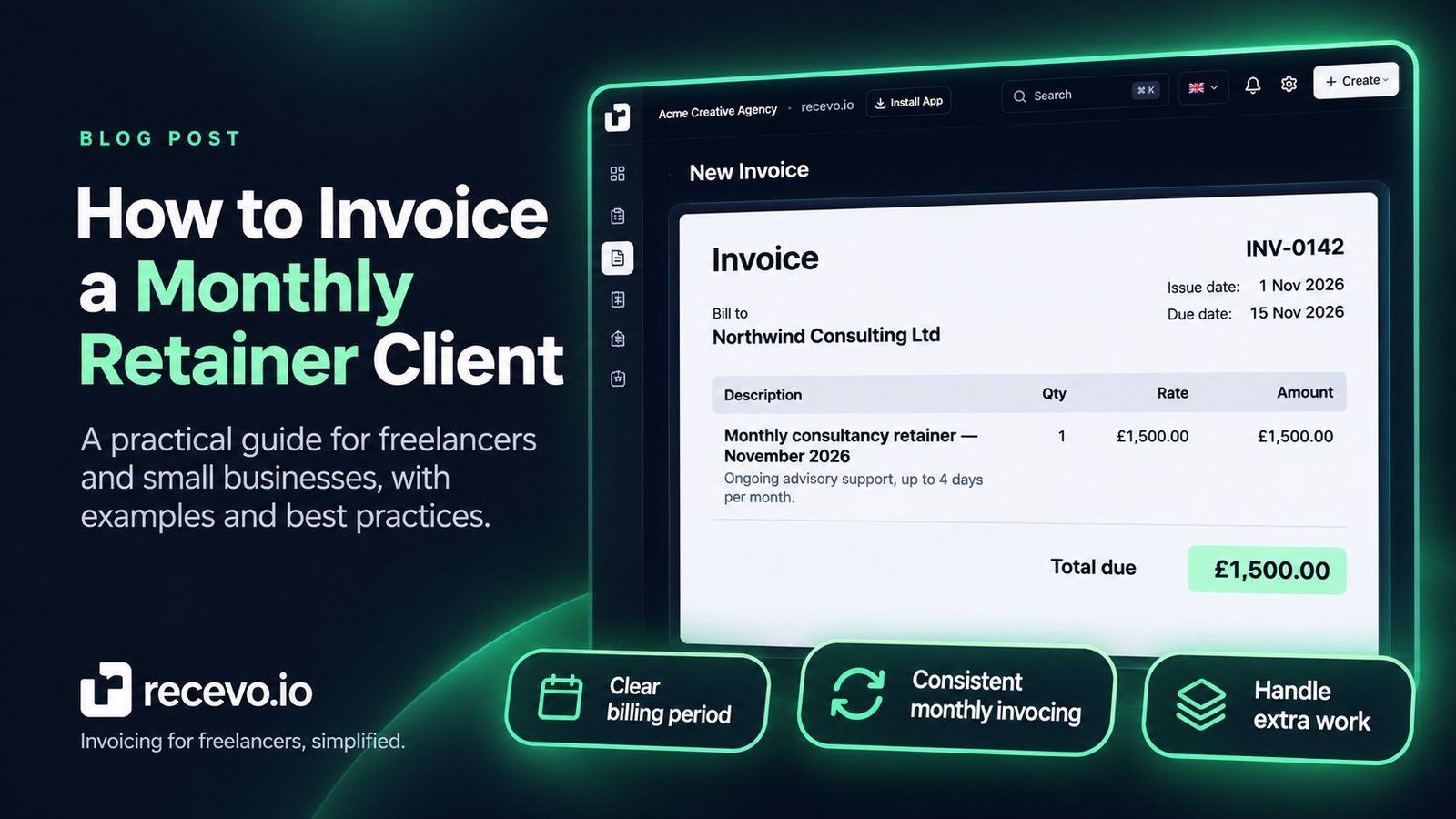
A monthly retainer can be one of the simplest ways to work with an ongoing client.
Instead of agreeing a new project every few weeks, the client pays an agreed amount each month for a defined service, amount of work or access to your time.
But the invoice still needs to explain exactly what the client is paying for.
Should you invoice at the start or end of the month?
What should the description say?
Should you list hours?
What happens when the client asks for work outside the retainer?
And how do you keep monthly invoices consistent without making them vague?
This guide explains a practical approach for freelancers, consultants and other independent workers.
recevo.io provides invoicing tools and general business information rather than financial, tax, accounting or legal advice. If you are unsure how a retainer arrangement should be structured for your circumstances, speak to an accountant, tax adviser or appropriate professional.
What is a monthly retainer?
A monthly retainer is an ongoing agreement where a client pays you a regular amount for an agreed service or commitment.
For example, a client might pay:
£1,500 per month for ongoing marketing support
or:
£2,000 per month for up to four days of consultancy
or:
£750 per month for website maintenance and support
Retainers are common among:
- consultants
- designers
- developers
- marketers
- copywriters
- virtual assistants
- photographers and creatives
- agencies
- other freelancers providing ongoing services
The important part is that both sides understand what the monthly fee covers.
The invoice should reflect that agreement rather than introducing a new interpretation each month.
Should you invoice a retainer in advance or in arrears?
Either can work.
The important thing is to agree the arrangement before the work begins and invoice consistently.
Monthly retainer in advance
Billing in advance means invoicing for the upcoming period.
For example, on 1 November you might invoice:
Monthly consultancy retainer — 1 to 30 November 2026
The client pays before or during the period in which you provide the service.
This can work particularly well where the client is paying to reserve:
- your availability
- a fixed amount of time
- ongoing access or support
- capacity in your schedule
It can also give a freelancer more predictable cash flow because the month's work is not completed before payment is requested.
If this is your arrangement, make it clear when agreeing the retainer.
For example:
Monthly retainer billed in advance on the 1st of each month.
Monthly retainer in arrears
Billing in arrears means invoicing after the period has finished.
For example, at the beginning of November you might invoice:
Monthly consultancy retainer — services provided during October 2026
This may make sense where the final amount depends on what happened during the month or where the client has established payment processes that work this way.
Neither method is automatically better.
Choose the method that matches your agreement and make sure the client understands when invoices will arrive.
Always show the billing period
One of the easiest ways to improve a retainer invoice is to state clearly which month or period it relates to.
Avoid a line item that only says:
Retainer — £1,500
Six months later, that description is not very helpful to you, your client or an accountant looking at the records.
Instead, use something like:
Monthly marketing retainer — November 2026
or:
Website support retainer — 1 November to 30 November 2026
or:
Consultancy retainer — November 2026, up to four days
The invoice number identifies the invoice.
The billing period identifies what period the payment covers.
Both are useful.
What should you write in a retainer invoice description?
The description should be clear enough that somebody who did not negotiate the original agreement can still understand the charge.
You do not normally need to reproduce the entire contract or statement of work.
A concise description is often better.
For example:
Monthly SEO consultancy retainer — November 2026
Ongoing website maintenance and support — November 2026
Monthly design retainer — up to 20 hours, November 2026
Marketing support retainer — November 2026, including campaign planning, reporting and ongoing advice
Development support retainer — 1 to 30 November 2026
If the retainer covers a specific allowance, mentioning that allowance can help too.
For example:
Monthly consultancy retainer — up to 3 days during November 2026
This makes the invoice easier to connect to the arrangement both sides agreed.
For more examples of writing clear line items, see Invoice Description Examples for Freelancers.
Do you need to list everything you did that month?
Not necessarily.
It depends on what the retainer actually buys.
If the client pays a fixed monthly amount for an agreed service, the invoice does not necessarily need to become a detailed timesheet.
For example, if the agreement is:
£1,000 per month for ongoing social media management
the invoice might simply state:
Social media management retainer — November 2026: £1,000
You can provide a separate monthly report if the client needs a breakdown of activity.
On the other hand, if the retainer buys a specific number of hours or days, it can be useful to mention that allowance.
For example:
Monthly copywriting retainer — up to 15 hours, November 2026
The invoice should make the charge understandable without becoming cluttered.
Should you put hours on a retainer invoice?
Only if hours are relevant to the agreement.
There is an important difference between:
£1,500 per month for ongoing consultancy
and:
£1,500 per month for up to 15 consulting hours
The second arrangement has an explicit time allowance.
If that is what you agreed, showing it on the invoice can help keep the terms clear.
But if the client is paying a fixed monthly fee for an outcome, service or reserved availability, turning every invoice into an hourly calculation may undermine the point of the retainer.
The invoice should follow the commercial arrangement rather than forcing every retainer into the same format.
What if the client does not use all of the retainer?
This should be decided in the retainer agreement rather than when you create the invoice.
For example, if the client pays for up to 10 hours per month but only uses six, what happens to the remaining four?
Possible arrangements include:
- unused time expires at the end of the month
- some unused time rolls into the following month
- all unused time rolls over
- the retainer reserves availability rather than buying a fixed number of hours
There is no universal answer.
The important thing is to agree the rule in advance.
If unused time expires, the invoice still normally reflects the agreed monthly retainer rather than reducing itself according to hours used.
If the charge varies according to actual usage, you may really have a different billing arrangement rather than a fixed monthly retainer.
What if the client asks for extra work?
This is one of the most important things to make clear in a retainer relationship.
Suppose the client pays:
£1,200 per month for ongoing design support
and then asks for a large brochure project that sits outside the agreed scope.
You need to decide whether that work is:
- included in the retainer
- deducted from an agreed time allowance
- charged separately
- quoted as a separate project
Do not wait until the invoice arrives to surprise the client with an additional charge.
Agree the extra work first.
If it is being added to the monthly invoice, keep it separate from the retainer line.
For example:
Monthly design retainer — November 2026: £1,200
Additional brochure design outside retainer scope: £450
Total: £1,650
That is much clearer than changing the retainer amount from £1,200 to £1,650 without explanation.
Keep the retainer amount consistent
If you have agreed a fixed monthly retainer, the invoice should normally reflect that agreed amount.
Consistency makes the arrangement easier for everyone.
If the retainer is £1,000 per month, invoices jumping between £950, £1,075 and £1,200 without explanation will create questions.
Where the amount changes, explain why.
For example:
Monthly support retainer — November 2026: £1,000
Additional support agreed 18 November: £200
Or, if the retainer itself has permanently changed, confirm the new arrangement with the client before invoicing it.
Use a consistent invoice schedule
Retainers work best when the invoicing routine is predictable.
For example:
Invoice on: 1st of every month
Payment due: within 7 days
or:
Invoice on: final working day of the month
Payment due: within 14 days
The exact terms are up to you and your client.
What matters is consistency.
If your client knows that the invoice arrives on the first working day of each month, they can build it into their own payment process.
Your existing agreement should also make clear whether the retainer covers the month ahead or the month just completed.
For more on choosing payment terms, see Freelance Invoice Payment Terms: What to Use.
Put an actual due date on the invoice
Do not make the client calculate when payment is due.
If your terms are 14 days, include the actual due date as well.
For example:
Invoice date: 1 November 2026
Payment terms: 14 days
Due date: 15 November 2026
That makes the expectation clear.
It also gives you an unambiguous date to work from if payment becomes overdue.
The UK's Small Business Commissioner similarly recommends making payment terms and the due date clear and agreeing the terms in advance.
What information should a retainer invoice include?
A retainer invoice is still an invoice, so it needs the normal information appropriate to your business.
For a UK invoice, that includes details such as:
- a unique invoice number
- your business details
- the customer's details
- a clear description of the service
- the date of supply
- the invoice date
- the amount being charged
- VAT where applicable
- the total owed
Sole traders and limited companies have some additional requirements.
On a retainer invoice, it is also useful to make particularly clear:
- the billing period
- what the retainer covers
- the payment due date
- any additional work being charged separately
- a PO or project reference where the client requires one
- how the customer should pay
For a broader invoice checklist, see What Should a Freelance Invoice Include?.
Example monthly retainer invoice
Imagine you provide ongoing marketing support for a client for £1,500 per month.
Your invoice could include:
Invoice number: INV-0086
Invoice date: 1 November 2026
Due date: 8 November 2026
Description:
Monthly marketing consultancy retainer — November 2026
Amount:
£1,500
Total due:
£1,500
Payment terms:
Payment due within 7 days.
If the client also requested £300 of additional work outside the retainer:
Monthly marketing consultancy retainer — November 2026: £1,500
Additional campaign landing page, agreed separately: £300
Total due: £1,800
The invoice remains simple, but the client can immediately see why the amount is different from a normal month.
Should the first retainer invoice be different?
It can be.
If your retainer is paid in advance, you might require the first invoice to be paid before ongoing work begins.
For example:
Monthly retainer payable in advance. Work begins once the first month's invoice has been paid.
That gives the relationship a clear starting point.
Some freelancers effectively treat this first payment in a similar way to an upfront project payment: it confirms the arrangement and reserves their availability.
Our guide Should Freelancers Ask for a Deposit? covers upfront payment considerations in more detail.
Do you need to create a completely new invoice every month?
You need a separate invoice record for each billing event, but you do not necessarily need to type the same client and service information from scratch every month.
With recevo.io, you can clone an existing invoice and use it as the starting point for the next one.
For example, you could clone October's retainer invoice and then update:
- the invoice number
- invoice date
- due date
- billing period
- any additional work
- any change to the retainer amount
Check the new invoice carefully before sending it.
recevo.io does not automatically create recurring invoices in the background, so you remain in control of when each monthly invoice is created and issued.
That is particularly useful if the details sometimes change from month to month.
Make it easy for the client to pay
A regular client has to pay you repeatedly, so removing unnecessary payment friction can make the process easier.
Your invoice should contain clear payment instructions.
If you connect your own Stripe account to recevo.io, eligible invoices can also include an online card payment option.
The customer can follow the payment link to Stripe, pay the balance, and the successful payment can be recorded against the invoice in recevo.io.
Alternatively, clients can continue paying by your usual method.
The important thing is that they know exactly how to pay and which invoice the payment relates to.
Keep track of which months have actually been paid
With an ongoing client, it becomes especially important not to confuse sending an invoice with receiving the money.
You may have issued January, February and March invoices, but that does not mean all three have been paid.
Record payments against the correct invoice as they arrive.
If you use the Bank feature in recevo.io, you can also import the statement you download from your bank and match incoming transactions against the relevant invoices.
That provides another check that the payment recorded in your invoicing records agrees with what actually reached your current account.
For clients paying several outstanding invoices in one transfer, the Bank feature can also suggest when one payment corresponds to several invoices.
What if a monthly retainer payment is late?
Treat the invoice in the same clear, professional way you would any other overdue invoice.
Check:
- that the invoice reached the right person
- that the due date has actually passed
- whether the client needs a PO or reference
- whether there is a query about the work
- whether their accounts team has scheduled payment
Then follow up politely.
Chase Reminders in recevo.io can identify invoices that need attention and draft a reminder email for you to send from your own address.
It does not send the message automatically, so you can review the wording and decide when to contact the client.
For more help with overdue invoices, see What to Do When a Client Doesn't Pay an Invoice.
Common monthly retainer invoicing mistakes
Writing only “retainer”
A vague line item makes the invoice harder to understand later.
Include the service and billing period.
Instead of:
Retainer
use:
Monthly content marketing retainer — November 2026
Forgetting whether you bill in advance or arrears
Make this part of the original agreement.
Otherwise, the client may interpret a November invoice as payment for October while you intended it to cover November.
Hiding extra work inside the retainer amount
If you have added a charge for work outside the usual scope, show it separately.
The client should be able to see why this month's invoice differs.
Changing payment terms each month
Regular arrangements benefit from predictable terms.
Avoid using seven days one month, 14 the next and 30 the month after unless there is a reason and the client understands it.
Assuming the client remembers the scope
You may know exactly what the £1,500 retainer means.
The person in accounts payable may not.
Give them enough information to connect the invoice with the service being purchased.
Forgetting to update a cloned invoice
Cloning last month's invoice saves time, but check every date and reference.
An invoice sent in November that still says October 2026 looks careless and can create confusion.
A monthly retainer invoice checklist
Before sending each month's invoice, check:
- Is the client information still correct?
- Is the invoice number unique?
- Is the invoice date correct?
- Is the due date correct?
- Does the description name the service?
- Is the billing month or period clearly stated?
- Does the amount match the agreed retainer?
- Is any work outside the retainer shown separately?
- Is VAT handled correctly where applicable?
- Have you included any required PO or project reference?
- Are the payment instructions clear?
- Have you removed anything copied from last month's invoice that no longer applies?
A two-minute check can prevent an ongoing error being repeated across months of invoices.
Frequently asked questions
What should a monthly retainer invoice say?
State what the retainer covers and which month or billing period it relates to.
For example:
Monthly design retainer — November 2026
If the agreement includes a specific allowance, you could make that clear too:
Monthly consultancy retainer — up to 3 days, November 2026
Should a retainer be invoiced in advance?
It can be.
Many retainers are billed in advance, particularly when the client is reserving availability or an agreed amount of capacity.
Others are invoiced in arrears.
The important thing is to agree the arrangement in advance and use it consistently.
Do I invoice a retainer every month?
For a monthly retainer, you would normally issue an invoice for each monthly billing period according to the arrangement with the client.
Keep each invoice as its own record and clearly state which period it covers.
Should I include hours on a retainer invoice?
Only if hours form part of the agreement.
If the client pays for up to 10 hours each month, mentioning that allowance can be useful.
If they pay a fixed fee for an ongoing service or reserved availability, you may not need an hourly breakdown.
What happens if I do more work than the retainer covers?
Agree how additional work will be handled before billing it.
You might quote it separately or add it as a separate line on the monthly invoice.
Avoid increasing the invoice without explaining why.
Do unused retainer hours roll over?
That depends on what you and the client agreed.
Unused time might expire, roll over in full, roll over up to a limit, or be irrelevant because the retainer pays for availability rather than a fixed number of hours.
Make the rule clear before the retainer begins.
Can I reuse last month's invoice?
Using the previous invoice as a starting point can save time, but each month's invoice should be a separate, accurate document.
recevo.io lets you clone an invoice, then update the dates, billing period and any other details before issuing the next one.
Can recevo.io automatically send a monthly recurring invoice?
No.
recevo.io does not currently create and send recurring invoices automatically.
You can clone an existing retainer invoice to make the next month's invoice quicker to prepare, while keeping control over when it is created and sent.
Make monthly invoicing predictable
A good retainer should make ongoing work simpler for both you and your client.
The invoice should do the same.
Use a consistent billing schedule, state the period clearly, describe what the retainer covers, separate any additional work, and give the client an unambiguous due date.
Once you have a format that works, keep it consistent from one month to the next.
With recevo.io, you can create and clone invoices, keep customer records organised, record payments, export professional PDFs, accept eligible card payments through Stripe and reconcile payments against statements you import from your bank.
Start here:
No signup. No subscription. No invoice limits. Just private, browser-based invoicing for independent workers.
Unlimited invoices, quotes & expenses · Free forever
Send your next invoice from recevo.io, and every one after it, free
Create the invoice, download a branded PDF or share a secure read-only link, then record the payment when it lands. Free forever, no account needed.
Free forever · No account · No card · No watermark · Opens in a new tab
Unlike most free invoice tools:
- Unlimited invoices and quotes
- Branded PDFs with no watermark
- Works offline in your browser
- Your data never leaves your device
- Expenses and profit tracking included
- No account, no card, no premium tier

“I set up my branding once - now everything I send looks professional.”