
Should Freelancers Ask for a Deposit Before Starting Work?
A deposit can protect freelancers from unpaid work, unclear commitment, and cash flow stress. Here’s when to ask for one, how much to request, and how to invoice it professionally.
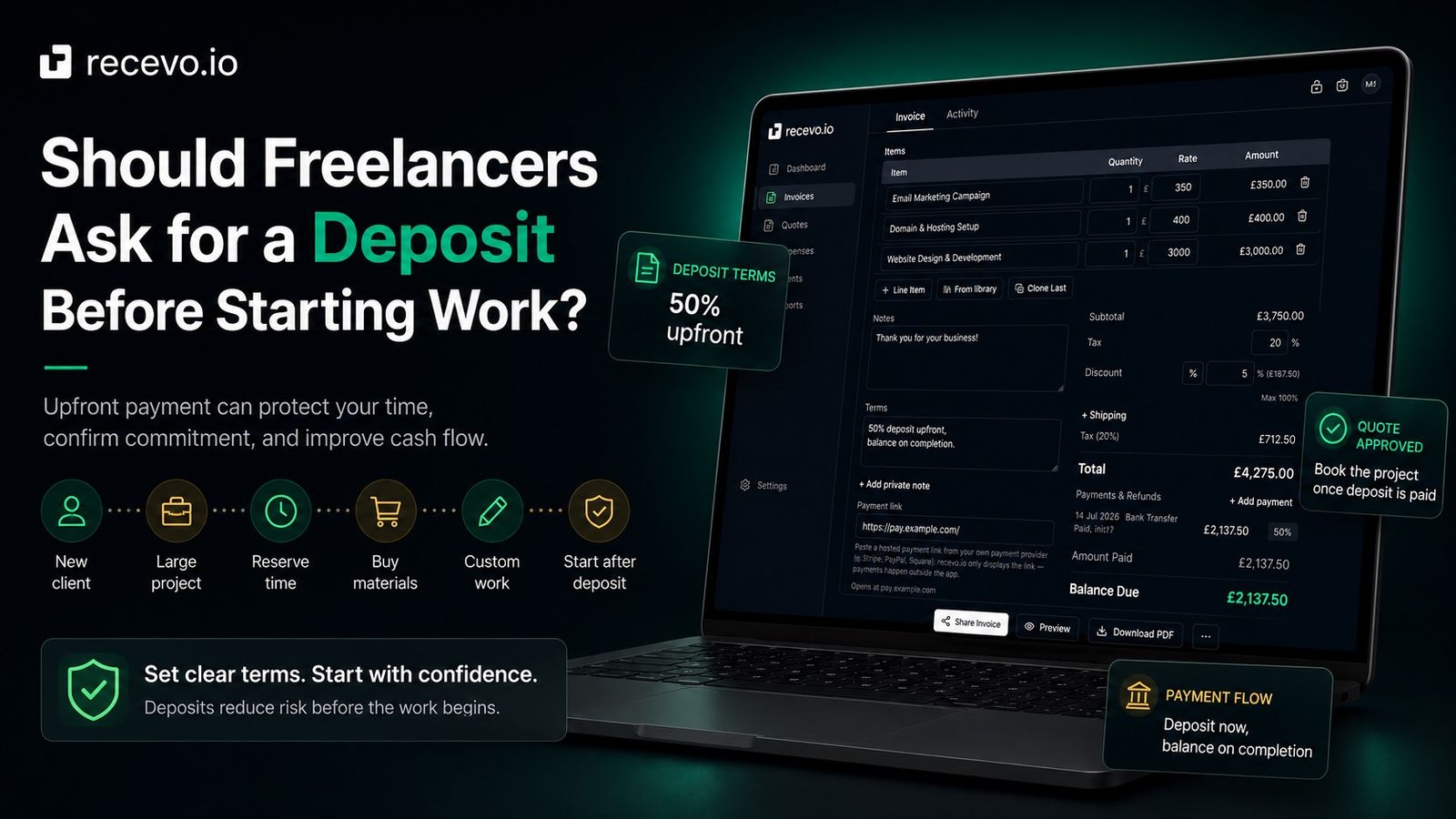
Asking for a deposit can feel awkward when you are freelancing.
You want to sound professional, not difficult. You want the client to feel confident, not pressured. You want to start the work, but you also do not want to take on all the risk before any money has been paid.
For many freelancers, sole traders, consultants, creatives, tradespeople, and independent workers, a deposit is a normal and sensible part of working with clients.
It can protect your time, improve cash flow, and make sure the client is genuinely committed before you start.
A deposit is not always necessary. For small jobs, trusted repeat clients, or quick one-off tasks, you may decide not to ask for one.
But for larger projects, new clients, custom work, or anything that requires you to reserve time, asking for payment upfront can be a very good idea.
This guide explains when freelancers should ask for a deposit, common deposit structures, how to explain upfront payment to clients, how to include deposit terms in a quote, and how recevo.io can help you create quotes, deposit invoices, and payment records without signing up for another account.
This is general business guidance, not legal or financial advice. If deposits, contracts, cancellations, or disputes are important for your work, consider getting professional advice.
What is a freelance deposit?
A freelance deposit is a payment made before the full work is completed.
It is usually paid before the project starts, before a slot is booked, or before a major stage of work begins.
For example, a freelancer might ask for:
- 50% upfront and 50% on completion
- 30% deposit before work starts
- a fixed booking fee
- the first month of a retainer in advance
- payment before materials are purchased
- staged payments at agreed project milestones
The deposit confirms that the client wants to move ahead.
It also means you are not carrying the full risk of the project alone.
Why freelancers ask for deposits
Freelancers often do the work before they get paid.
That creates risk.
You may spend hours planning, designing, writing, building, consulting, travelling, buying materials, or reserving time in your diary before the client has paid anything.
A deposit helps reduce that risk.
It can help you:
- confirm the client is serious
- protect your time
- avoid doing large amounts of unpaid work
- improve cash flow
- cover initial costs or materials
- reserve project time with confidence
- reduce the impact of cancellations
- set a more professional tone from the start
A deposit also creates a clearer commitment on both sides.
The client has made a financial commitment. You have committed time and capacity to the project.
That can make the working relationship feel more structured.
When should freelancers ask for a deposit?
A deposit is especially useful when the work involves risk, time, cost, or uncertainty.
You should consider asking for a deposit when:
The client is new
If you have never worked with the client before, you do not yet know how they communicate, approve work, or pay invoices.
A deposit helps reduce the risk of starting work for someone who may later delay, disappear, or change direction.
This does not mean you distrust the client.
It simply means both sides are making a commitment before work starts.
The project is large
The bigger the project, the more important payment structure becomes.
If a project will take several days, weeks, or months, waiting until the end to invoice the full amount can put pressure on your cash flow.
A deposit or milestone payment structure spreads the risk more fairly.
You need to reserve time
If you are blocking out time in your calendar, turning down other work, or scheduling the client into a limited slot, a deposit can protect that booking.
This is common for designers, photographers, consultants, tradespeople, coaches, event suppliers, and other independent workers whose time is their main asset.
You need to buy materials or pay costs upfront
Some work requires you to spend money before delivery.
That might include materials, subcontractors, licences, printing, travel, equipment hire, software, stock, or specialist services.
In those cases, asking for a deposit can stop you from funding the client’s project from your own pocket.
The work is custom
Custom work can be hard to resell or reuse if the client cancels.
For example, a custom design, written content, consulting report, website build, commissioned artwork, or tailored project plan may have little value outside that client relationship.
A deposit helps protect the time spent creating something specific.
The client has a slow approval process
Some clients take a long time to review, approve, or pay.
If you know a project may involve several approval stages, a deposit can help make the project more sustainable.
You can also combine this with milestone invoices so payment is not delayed until the very end.
When might a deposit not be needed?
Not every job needs a deposit.
You might skip the deposit when:
- the project is small
- the work is quick
- the client is trusted and reliable
- payment is due immediately after delivery
- the relationship is ongoing and established
- you are working under an existing retainer
- the admin of deposit invoicing is not worth it
For example, if a repeat client asks for a small one-hour task and always pays on time, a deposit may be unnecessary.
The goal is not to add friction for the sake of it.
The goal is to manage risk sensibly.
How much deposit should freelancers ask for?
There is no single right deposit percentage.
The best amount depends on the project, client, industry, and risk.
Here are common options.
25% deposit
A 25% deposit is a gentle upfront commitment.
It may work well for clients who are nervous about paying too much before work begins, or for projects where the upfront risk is moderate.
Example:
“25% deposit due before work begins. Remaining balance due on completion.”
This can be a good compromise when you want some protection without making the initial payment feel too heavy.
30% deposit
A 30% deposit is common for project-based work.
It gives you meaningful upfront commitment while leaving most of the payment tied to delivery.
Example:
“30% deposit due before work begins. Remaining balance due after final delivery.”
This works well for many freelance projects, especially creative, consulting, web, design, writing, and project-based services.
50% deposit
A 50% deposit is stronger.
It is useful when the work is substantial, custom, time-sensitive, or difficult to resell if the client cancels.
Example:
“50% deposit due before work begins. Remaining 50% due on completion.”
This is simple and easy to understand.
For many freelancers, 50/50 is the clearest deposit structure.
Fixed booking fee
Instead of a percentage, you can charge a fixed booking fee.
Example:
“A £250 booking fee is required to reserve the project start date. The remaining balance will be invoiced on completion.”
This works well when you want to protect your diary or cover initial admin, planning, or setup time.
Milestone payments
For larger projects, milestone payments may be better than one deposit and one final invoice.
Example:
“30% due before work begins, 40% due after first delivery, and 30% due on final completion.”
Milestones are useful when a project has clear stages.
They also reduce the risk of doing a large amount of work before receiving the next payment.
Retainer paid in advance
For ongoing work, the deposit may effectively be the first retainer payment.
Example:
“Monthly retainer is payable in advance. Work begins once the first month’s invoice has been paid.”
This works well for ongoing consulting, marketing, design, development, content, or support arrangements.
How to ask for a deposit professionally
The key is to make the deposit sound like a normal part of your process.
Do not apologise for it.
Do not make it sound unusual.
Do not over-explain unless the client asks.
A simple line is usually enough:
“To reserve the project slot, I ask for a 50% deposit before work begins. The remaining balance is due on completion.”
Or:
“For new projects, I invoice a 30% deposit upfront, with the balance due once the work is complete.”
This sounds professional because it frames the deposit as part of your standard workflow.
How to explain deposits to clients
Some clients may ask why a deposit is needed.
A calm explanation helps.
For example:
“The deposit confirms the project slot and allows me to schedule the work properly. It also keeps the payment structure clear for both of us.”
Or:
“The upfront payment reserves the time in my diary and covers the initial planning stage. The remaining balance is due after delivery.”
You do not need to make the client feel like you are worried they will not pay.
Frame the deposit around scheduling, commitment, planning, and clarity.
Include deposit terms in the quote
The best time to mention a deposit is before the invoice.
Ideally, include deposit terms in your quote, estimate, proposal, or project confirmation.
That way, the client knows the payment structure before they approve the work.
A quote might include:
“Project total: £1,200. 50% deposit due before work begins. Remaining 50% due on completion.”
Or:
“30% deposit required to confirm the project. Final balance due within 14 days of delivery.”
This avoids surprising the client later.
recevo.io supports quotes and estimates as well as invoices, so you can define the deposit terms in the quote and then convert accepted work into an invoice when it is time to bill.
How to invoice for a deposit
A deposit invoice should be clear about what the payment is for.
Do not just write “Deposit” with no context.
Use a line item that explains the project and payment stage.
For example:
“50% deposit for website design project”
or:
“30% upfront payment for brand identity package”
The invoice should include:
- your details
- client details
- invoice number
- invoice date
- payment due date
- project description
- deposit amount
- tax if relevant
- total due
- payment instructions
- payment terms
You may also want to reference the quote number or project name.
That makes it easier for the client to understand what the deposit relates to.
Should you start work before the deposit is paid?
If the deposit is part of your terms, it is usually best not to start substantial work until it has been paid.
Otherwise, the deposit loses its purpose.
You can still do light admin, scheduling, or onboarding if you choose, but be careful about starting the real work before the client has made the agreed payment.
A clear message might say:
“Once the deposit invoice is paid, I’ll confirm the project start date and begin the first stage.”
This keeps the process simple and professional.
What if the client refuses to pay a deposit?
Some clients may not want to pay upfront.
That does not always mean they are a bad client. They may have internal finance rules, previous bad experiences, or a standard supplier process.
You can decide how flexible to be.
Options include:
- a smaller deposit
- a shorter first milestone
- payment in advance for only the first stage
- a signed agreement before work begins
- shorter payment terms
- payment on delivery but before final files are released
- declining the project if the risk feels too high
The important thing is to decide intentionally.
If you give up the deposit, consider how you are protecting yourself instead.
Deposit wording examples
Here are some simple deposit terms you can adapt.
50% deposit
“50% deposit due before work begins. The remaining balance is due on completion.”
30% deposit
“30% deposit required to confirm the project. Remaining balance due after final delivery.”
Booking fee
“A booking fee of £250 is required to reserve the project start date. The remaining balance will be invoiced separately.”
Milestone payments
“Payment will be split across three milestones: 30% before work begins, 40% after first delivery, and 30% on completion.”
Retainer in advance
“Monthly retainer payable in advance. Work begins once the first month’s invoice has been paid.”
Deposit before materials
“Deposit due before materials are ordered. Remaining balance due when the work is complete.”
Use these as starting points, not legal templates. If your terms need to be contractually precise, get appropriate advice.
Common deposit mistakes to avoid
Asking too late
Do not wait until the client has already approved the project and expects work to begin before mentioning a deposit.
Introduce the deposit during the quote or proposal stage.
Being vague
Avoid unclear wording like:
“Some payment upfront may be needed.”
Be specific:
“30% deposit required before work begins.”
Starting work anyway
If the deposit is required before work begins, wait until it is paid.
Otherwise, the client learns that the term is optional.
Not issuing a proper invoice
A deposit should still be invoiced clearly.
The client needs a record of what they paid and what it relates to.
Forgetting the final balance
Once the deposit is paid, make sure the final invoice reflects what has already been paid.
Track the deposit properly so the client is not confused later.
Not matching the quote
If your quote says 30% deposit, do not send an invoice for 50% unless the client agreed to the change.
Keep the quote, deposit invoice, and final invoice aligned.
How recevo.io helps with deposits
recevo.io is private, no-signup invoicing for independent workers.
It helps you create professional quotes and invoices in your browser, without creating an account, email address, password, trial, or subscription.
For deposit workflows, you can use recevo.io to:
- create a quote with clear payment terms
- include deposit wording in the quote
- export a professional quote PDF
- share quotes with encrypted read-only links
- convert accepted quotes into invoices
- create a deposit invoice
- set invoice due dates
- track whether the deposit has been paid
- record payments and refunds
- add private notes
- clone documents for repeat workflows
- keep invoice history organised
This keeps the deposit process more structured than a loose email thread or spreadsheet template.
A simple deposit workflow
A clear deposit workflow might look like this:
- Discuss the project with the client.
- Send a quote with scope, deliverables, price, and deposit terms.
- Wait for the client to approve the quote.
- Create a deposit invoice.
- Send the invoice as a professional PDF or encrypted read-only link.
- Wait for payment before starting substantial work.
- Record the payment.
- Complete the work.
- Send the final invoice for the remaining balance.
recevo.io supports this flow from quote to invoice, so you do not need to rebuild documents manually.
Why browser-based invoicing matters
recevo.io is browser-based by design.
Your normal workspace lives in your browser, not in a central recevo.io invoice database.
That is a deliberate privacy and ownership choice.
It means you can create quotes, invoices, and payment records without handing your normal invoicing workspace to a central cloud database.
There is an important trade-off.
If browser data is cleared, your local workspace can be lost unless you have a backup.
recevo.io supports manual JSON Backup & Restore. Backup files are plain JSON for portability and transparency, so they may contain sensitive business data and should be stored securely.
Optional Encrypted Cloud Backup is also available as an off-device safety net. It is opt-in, off by default, and is not real-time cloud sync or team collaboration.
Is recevo.io accounting software?
No.
recevo.io is an invoicing-first tool for independent workers.
It includes useful depth around quotes, expenses, payment tracking, live P&L visibility, categories, tax classification, and accountant-ready exports, but it is not accounting software, tax filing software, payroll software, or a replacement for your accountant.
The goal is simpler:
Quote the work. Invoice the deposit. Track payment. Keep your records organised.
Frequently asked questions
Should freelancers ask for a deposit?
Freelancers should consider asking for a deposit when the project is large, the client is new, the work is custom, time must be reserved, or upfront costs are involved.
A deposit is not always needed for small tasks or trusted repeat clients, but it can be a useful way to reduce risk.
How much deposit should a freelancer ask for?
Common deposit amounts include 25%, 30%, or 50%. Some freelancers use fixed booking fees or milestone payments instead.
The right amount depends on the project size, risk, client relationship, and type of work.
Is it normal to ask for 50% upfront?
Yes, 50% upfront is common in many freelance project workflows, especially for custom or project-based work.
It is usually best to mention this before the client approves the quote.
How do you ask a client for a deposit?
Keep it simple and professional.
For example:
“To reserve the project slot, I ask for a 50% deposit before work begins. The remaining balance is due on completion.”
Should I send an invoice for a deposit?
Yes. A deposit should be invoiced clearly so both you and the client have a record of what was paid, when it was due, and what project it relates to.
Should I start work before the deposit is paid?
If your terms say the deposit is due before work begins, it is usually best to wait until payment is received before starting substantial work.
Otherwise, the deposit term becomes harder to enforce.
Can recevo.io create deposit invoices?
Yes. recevo.io lets you create professional invoices in your browser, including deposit invoices with clear line items, due dates, payment terms, PDF export, and payment tracking.
Do I need an account to use recevo.io?
No. Open the app and start invoicing — no account required.
recevo.io does not require an email address, password, trial, or subscription to use the core no-signup app.
Create your first deposit invoice
A deposit can make freelance projects clearer, safer, and easier to manage.
Agree the terms early. Put them in the quote. Send a clear deposit invoice. Track the payment before starting substantial work.
With recevo.io, you can create quotes, deposit invoices, professional PDFs, payment records, and organised browser-based records without signing up.
Create your first quote or invoice here:
No signup. No subscription. No invoice limits. Just private, browser-based invoicing for independent workers.
Unlimited invoices, quotes & expenses · Free forever
See what is outstanding at a glance
Create the invoice, record each payment as it arrives, and let the status tell you who still owes what. Free, private, no sign-up.
Free forever · No account · No card · No watermark · Opens in a new tab
Unlike most free invoice tools:
- Unlimited invoices and quotes
- Branded PDFs with no watermark
- Works offline in your browser
- Your data never leaves your device
- Expenses and profit tracking included
- No account, no card, no premium tier

“Send a quote, convert it to an invoice in one click - tracking payments is so much easier.”