
What Payment Terms Should Freelancers Put on an Invoice?
Clear payment terms help clients understand when to pay, how to pay, and what reference to use. Here’s how freelancers can choose practical invoice payment terms.
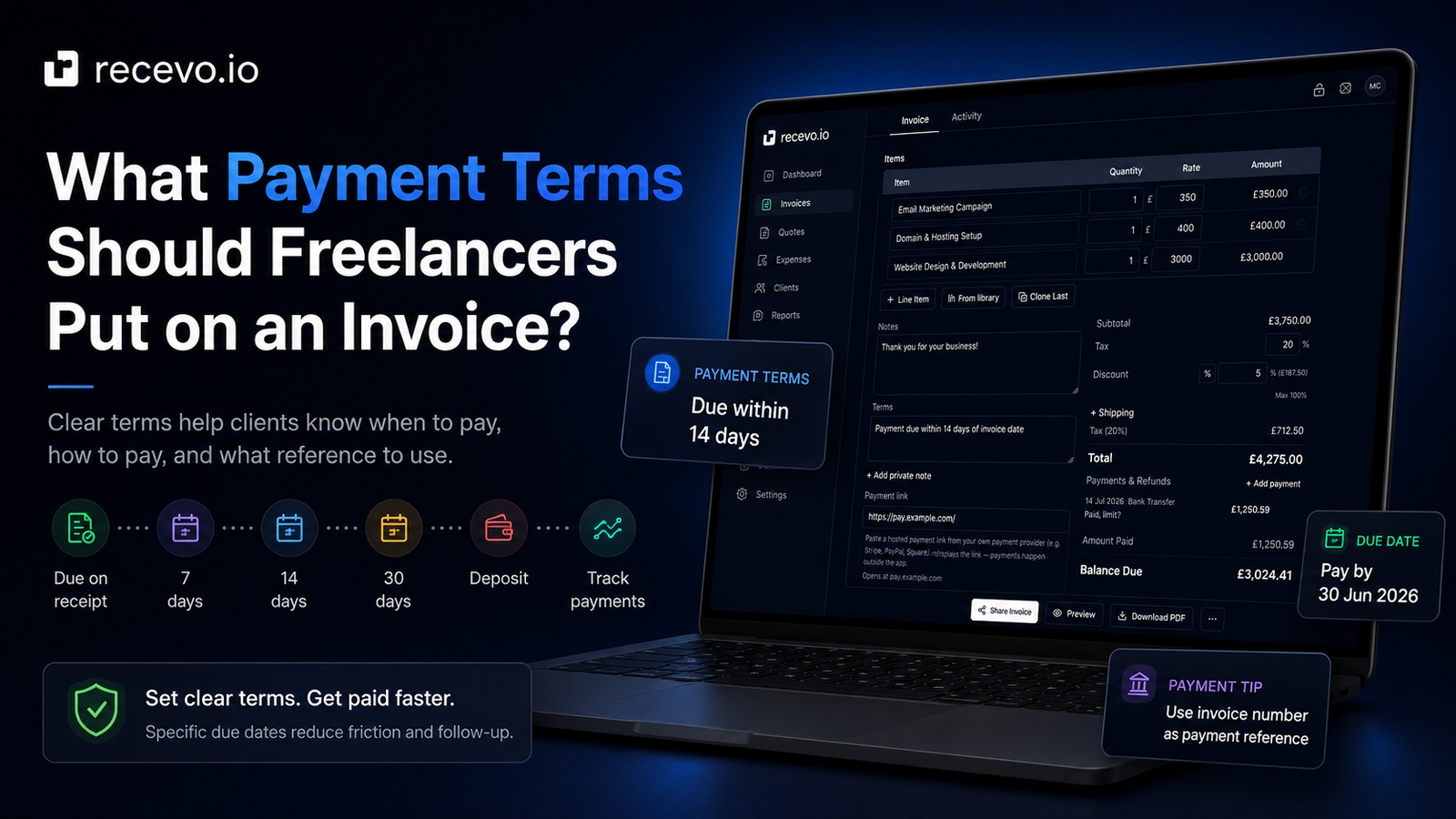
Payment terms are one of the most important parts of a freelance invoice.
They tell the client when payment is due, how payment should be made, and what happens next if the invoice is not paid on time.
Without clear payment terms, clients may delay, misunderstand, or need to ask follow-up questions before paying. That creates extra admin for you and more friction for them.
For freelancers, sole traders, consultants, tradespeople, creatives, and independent workers, payment terms do not need to be complicated. They just need to be clear, consistent, and easy for the client to act on.
This guide explains common freelance invoice payment terms, when to use 7-day, 14-day, or 30-day terms, what wording to include, and how recevo.io can help you create invoices with clear payment details.
This is general guidance, not legal advice. If your payment terms need to be legally specific, or if you are dealing with late payment, contracts, or debt recovery, check official guidance or speak to a professional adviser.
What are invoice payment terms?
Invoice payment terms explain when and how a client should pay an invoice.
They usually cover:
- the payment due date
- how many days the client has to pay
- accepted payment methods
- payment reference instructions
- deposit or upfront payment requirements
- staged or milestone payment details
- late-payment wording, if relevant
Payment terms are not just a formality.
They help the client process the invoice correctly and give you a clear basis for follow-up if payment is late.
For example, “Payment due within 14 days” is much clearer than sending an invoice with no due date at all.
Even better:
“Payment due by 30 June 2026. Please use invoice number INV-0042 as the payment reference.”
That gives the client a specific date and a clear instruction.
Why payment terms matter for freelancers
Freelancers often rely on regular cash flow.
A late invoice can affect bills, tax planning, software subscriptions, subcontractors, materials, and your own personal income.
Clear payment terms help reduce that risk.
They make it easier to:
- set expectations before payment is due
- avoid awkward conversations later
- follow up politely if payment is late
- track overdue invoices
- match payments to invoice numbers
- keep cleaner records for accountant handoff
Good payment terms also make you look more professional.
They show that your invoicing process is organised, not improvised.
Common freelance invoice payment terms
There is no single payment term that works for every freelancer.
The right choice depends on the type of work, the client relationship, your cash flow, the size of the invoice, and what was agreed before the work started.
Here are the most common options.
Payment due on receipt
“Payment due on receipt” means the client should pay as soon as they receive the invoice.
This can work well for small invoices, quick jobs, one-off work, or clients who are already expecting the invoice.
Example wording:
“Payment due on receipt.”
Or slightly clearer:
“Payment is due on receipt of this invoice.”
The advantage is speed.
The disadvantage is that some clients may not treat it as a specific deadline. For that reason, many freelancers prefer using an actual due date as well.
For example:
“Payment due on receipt. Please pay by 30 June 2026.”
7-day payment terms
Seven-day payment terms are common for freelancers who want faster payment.
They can work well when:
- the invoice amount is relatively small
- the client is an independent business or small company
- the work has already been delivered
- the client is used to paying quickly
- you have agreed short terms upfront
Example wording:
“Payment due within 7 days.”
Better:
“Payment due within 7 days, by 30 June 2026.”
Seven-day terms are clear and reasonable for many freelance projects, but they should ideally be agreed before the invoice is sent.
If a client expects 30 days and you suddenly invoice on 7-day terms, that can create friction.
14-day payment terms
Fourteen-day payment terms are a useful middle ground.
They give the client time to process the invoice without leaving you waiting too long.
This can be a good default for freelancers, especially for regular client work, small business clients, creative projects, consulting, and services where the client does not have a long internal payment cycle.
Example wording:
“Payment due within 14 days.”
Better:
“Payment due within 14 days, by 30 June 2026.”
For many independent workers, 14 days feels practical: not too demanding, not too slow.
30-day payment terms
Thirty-day payment terms are common in business invoicing.
They may be expected by larger clients, agencies, public sector organisations, or companies with formal finance processes.
Example wording:
“Payment due within 30 days.”
Better:
“Payment due within 30 days, by 30 June 2026.”
The advantage is that 30-day terms may align better with client payment runs.
The disadvantage is that they can stretch freelancer cash flow, especially if the project took several weeks before the invoice was even sent.
If you use 30-day terms, make sure you are comfortable with the delay before starting the work.
Deposit or upfront payment terms
For larger projects, it can be sensible to ask for a deposit or upfront payment.
This helps protect your time and cash flow before committing to a significant block of work.
Common examples include:
- 50% upfront, 50% on completion
- 30% deposit, 40% milestone, 30% final payment
- payment in advance for the first month of a retainer
- deposit required before work is scheduled
Example wording:
“50% deposit due before work begins. Remaining balance due on completion.”
Or:
“Project will be scheduled once the initial deposit invoice has been paid.”
Deposits are especially useful for new clients, large projects, custom work, or anything that requires you to reserve time.
Milestone payment terms
Milestone payments split a project into stages.
Instead of waiting until the end, you invoice when agreed stages are reached.
This can work well for:
- web design projects
- consulting engagements
- large creative projects
- building or trade work
- multi-month contracts
- projects with clear phases
Example wording:
“Payment will be invoiced in three stages: 30% on project start, 40% after first delivery, and 30% on final completion.”
Milestone terms help keep cash flow healthier and reduce risk for both sides.
The client does not pay everything upfront, and you do not wait until the entire project is finished.
Retainer payment terms
Retainers are common for ongoing freelance work.
A client pays a regular amount for a defined period, set of services, or reserved availability.
Payment might be monthly in advance, monthly in arrears, or on a recurring schedule.
Example wording:
“Monthly retainer payable in advance. Payment due within 7 days of invoice date.”
Or:
“Monthly retainer invoice issued on the 1st of each month, with payment due within 14 days.”
For retainers, consistency matters.
Use the same invoice schedule, payment terms, and reference style each month so both sides know what to expect.
Which payment terms should freelancers choose?
For many freelancers, a good starting point is:
Payment due within 14 days.
It is clear, reasonable, and faster than 30-day terms.
But the best payment term depends on context.
Use shorter terms when:
- the work is small or fast
- the client is used to quick payment
- cash flow matters
- you have agreed short terms upfront
- the invoice is for a deposit or milestone
Use longer terms when:
- the client has formal finance processes
- you work with larger organisations
- 30-day terms were agreed in advance
- the project fee already accounts for the payment delay
- the relationship is established and reliable
The key is to agree terms early.
Do not wait until the invoice is overdue to discover that you and the client had different expectations.
Always include a specific due date
Payment terms are helpful, but a specific due date is clearer.
Compare these two examples:
“Payment due within 14 days.”
“Payment due within 14 days, by 30 June 2026.”
The second one is easier for the client.
They do not need to calculate the date. They can see exactly when payment is expected.
A specific due date also makes your own tracking easier. You can see which invoices are due soon, which are overdue, and which need follow-up.
recevo.io lets you set issue dates and due dates on invoices, so your PDF clearly shows when payment is expected.
Include payment instructions
Payment terms should be paired with payment instructions.
The due date tells the client when to pay.
Payment instructions tell them how to pay.
Depending on your business, this might include:
- bank transfer details
- payment reference
- payment link
- accepted payment methods
- currency
- international transfer details
- cheque details, if relevant
- contact details for payment questions
If you want the client to use the invoice number as the payment reference, say so.
Example wording:
“Please use invoice number INV-0042 as the payment reference.”
This helps you match incoming payments to the right invoice.
Keep the wording simple
Payment terms should be easy to understand.
Avoid overly complex wording unless you need it for a specific reason.
Simple examples include:
“Payment due within 7 days.”
“Payment due within 14 days.”
“Payment due by 30 June 2026.”
“Payment due on receipt.”
“50% deposit due before work begins. Remaining balance due on completion.”
“Please use the invoice number as the payment reference.”
For most freelance invoices, clarity is better than legal-sounding language.
If you need formal contract wording, get appropriate advice.
Put payment terms in the right place
Your payment terms should appear on the invoice itself.
You can also mention them in the invoice email.
For example, your email might say:
“Please find attached invoice INV-0042 for the completed design work. The total due is £950, with payment due by 30 June 2026.”
This makes the due date visible before the client even opens the PDF.
The invoice itself should still include the full payment terms and instructions.
Agree terms before sending the invoice
Payment terms work best when the client knows about them before the invoice arrives.
Ideally, include payment terms in:
- your quote
- your estimate
- your proposal
- your contract
- your project confirmation email
- your onboarding message
Then repeat them on the invoice.
For example, if your quote says payment is due within 14 days, the invoice should match that.
This reduces surprises and makes follow-up easier if the client pays late.
recevo.io supports quotes and estimates as well as invoices, so you can define terms earlier in the workflow and then convert accepted quotes into invoices.
What if the client asks for longer terms?
Some clients may ask for longer payment terms.
For example, a larger business may request 30, 45, or 60 days.
You can decide whether that works for you.
Before agreeing, consider:
- how reliable the client is
- how large the invoice is
- how much cash flow matters
- whether the price should reflect the delay
- whether you need a deposit
- whether you can pause work if payment is late
- whether the client has a formal payment process
You do not have to accept every request.
But if you do accept longer terms, make sure they are written clearly.
What if the client pays late?
If the due date passes and payment has not arrived, follow up calmly.
Start by checking:
- the invoice was sent to the right person
- the due date has passed
- the payment details were correct
- the client did not request a revised invoice
- the payment has not arrived under a different reference
Then send a polite reminder.
Example wording:
“Just a quick reminder that invoice INV-0042 was due on 30 June 2026. I’ve attached the invoice again for convenience. Please let me know if you need anything else from me to process it.”
If payment remains overdue, you may need firmer follow-up or formal advice.
The best defence is having clear invoice terms and good records from the start.
Should you mention late fees or interest?
Some freelancers include late-payment wording on invoices.
Whether you should do this depends on your country, contract, client type, and how formal your business process is.
Do not add late fees, interest, or penalties unless you understand the rules that apply to your situation.
If you want to include late-payment wording, keep it accurate and check official guidance or speak to an adviser.
A softer version might be:
“Please contact me before the due date if there are any issues processing payment.”
This encourages communication without making a legal claim.
Common payment term mistakes to avoid
Leaving payment terms blank
If the invoice does not say when payment is due, the client may not prioritise it.
Always include a clear due date or payment term.
Only saying “Net 30”
Some clients understand “Net 30”, but not everyone does.
Plain English is often better:
“Payment due within 30 days, by 30 June 2026.”
Changing terms without warning
If you normally use 30-day terms and suddenly send a 7-day invoice without agreement, the client may push back.
Agree terms before the invoice is sent.
Hiding payment details
Do not make the client search for how to pay.
Payment instructions should be easy to find.
Forgetting the payment reference
If you want the client to use the invoice number as the reference, say so clearly.
This makes reconciliation easier.
Not tracking due dates
A due date is only useful if you track it.
Use a system that helps you see which invoices are sent, paid, and overdue.
How recevo.io helps with invoice payment terms
recevo.io is private, no-signup invoicing for independent workers.
It helps you create professional invoices in your browser with clear payment details, due dates, PDF export, encrypted sharing, payment tracking, and organised records.
With recevo.io, you can create invoices with:
- customer details
- invoice numbers
- issue dates
- due dates
- line items
- tax, discounts, and shipping
- notes
- payment terms
- PDF export
- encrypted sharing
- payment and refund tracking
- private notes
- locking
- cloning
- audit history
You can open the app and start invoicing — no account required.
No email address. No password. No trial. No subscription needed for the core no-signup app.
Track payment after the invoice is sent
Payment terms are only useful if you know what happens next.
After sending an invoice, you need to track whether it has been paid.
recevo.io lets you record payments and refunds against invoices, including payment method, date, and notes. The balance due updates as transactions are added.
That means your invoice record remains useful after the PDF has been sent.
You can see what has been created, sent, paid, or still needs attention.
Keep payment terms consistent across quotes and invoices
If you send quotes before invoices, your payment terms should match the agreed quote.
For example, if your quote says:
“50% deposit due before work begins. Remaining balance due on completion.”
your invoices should follow that structure.
recevo.io includes quotes and estimates alongside invoices. When a quote is accepted, you can convert it into an invoice with one click, carrying over the details automatically.
That helps reduce manual retyping and keeps your workflow consistent.
Your normal workspace lives in your browser
recevo.io is browser-based by design.
Your normal workspace is not stored in a central recevo.io invoice database. It lives in your browser.
That is a deliberate privacy and ownership choice.
The trade-off is that if browser data is cleared, your local workspace can be lost unless you have a backup.
recevo.io supports manual JSON Backup & Restore. Backup files are plain JSON for portability and transparency, so they may contain sensitive business data and should be stored securely.
Optional Encrypted Cloud Backup is also available as an off-device safety net. It is opt-in, off by default, and is not real-time cloud sync or team collaboration.
Is recevo.io accounting software?
No.
recevo.io is an invoicing-first tool for independent workers.
It includes useful depth around quotes, expenses, payment tracking, live P&L visibility, categories, tax classification, and accountant-ready exports, but it is not accounting software, tax filing software, payroll software, or a replacement for your accountant.
The goal is simpler:
Create clear invoices. Send professional PDFs. Track what has been paid.
Payment terms wording examples
Here are some simple examples you can adapt.
Due on receipt
“Payment is due on receipt of this invoice. Please use the invoice number as the payment reference.”
7-day terms
“Payment is due within 7 days, by [Due Date]. Please use invoice number [Invoice Number] as the payment reference.”
14-day terms
“Payment is due within 14 days, by [Due Date]. Payment details are included on this invoice.”
30-day terms
“Payment is due within 30 days, by [Due Date]. Please contact me before the due date if there are any issues processing payment.”
Deposit terms
“50% deposit due before work begins. The remaining balance is due on completion.”
Milestone terms
“Payment will be invoiced at agreed project milestones. Each milestone invoice is due within 14 days.”
Retainer terms
“Monthly retainer invoice issued in advance. Payment is due within 7 days of the invoice date.”
Frequently asked questions
What payment terms should freelancers use?
Many freelancers use 7-day, 14-day, or 30-day payment terms. A practical default is often 14 days, but the right choice depends on the client, project, amount, and what was agreed before work started.
Is 7 days too short for invoice payment terms?
Not necessarily. Seven-day terms can work well for small projects, fast-turnaround work, deposits, or clients who are used to paying quickly. It is best to agree short terms before sending the invoice.
Are 30-day payment terms normal?
Yes, 30-day terms are common, especially with larger businesses or clients that have formal payment processes. The downside is slower cash flow, so freelancers should decide whether that works for them.
Should I include a due date as well as payment terms?
Yes. A specific due date is clearer than only saying “7 days” or “14 days”. For example: “Payment due within 14 days, by 30 June 2026.”
What should payment instructions include?
Payment instructions should explain how the client should pay and what reference to use. This may include bank details, a payment link, currency, accepted payment methods, and the invoice number as the payment reference.
Can I charge late fees on overdue invoices?
That depends on your country, contract, and client type. Do not add late fees, interest, or penalties unless you understand the rules that apply. Check official guidance or speak to an adviser if needed.
Can recevo.io track invoice payments?
Yes. recevo.io lets you record payments and refunds against invoices, including payment method, date, and notes. The invoice balance updates as transactions are added.
Do I need an account to use recevo.io?
No. Open the app and start invoicing — no account required.
recevo.io does not require an email address, password, trial, or subscription to use the core no-signup app.
Create invoices with clear payment terms
Clear payment terms make invoices easier to process and easier to follow up.
Choose terms that fit the project. Add a specific due date. Include payment instructions. Track what happens after the invoice is sent.
With recevo.io, you can create professional invoices, export PDFs, include payment terms, record payments, and keep your invoicing workflow organised in your browser.
Create your first invoice here:
No signup. No subscription. No invoice limits. Just private, browser-based invoicing for independent workers.