
How to Invoice When You’re Not VAT Registered: UK Guide
You do not need to be VAT registered to send professional invoices. This UK guide explains what non-VAT-registered freelancers and sole traders should include, what to leave off, and whether you need to mention VAT at all.
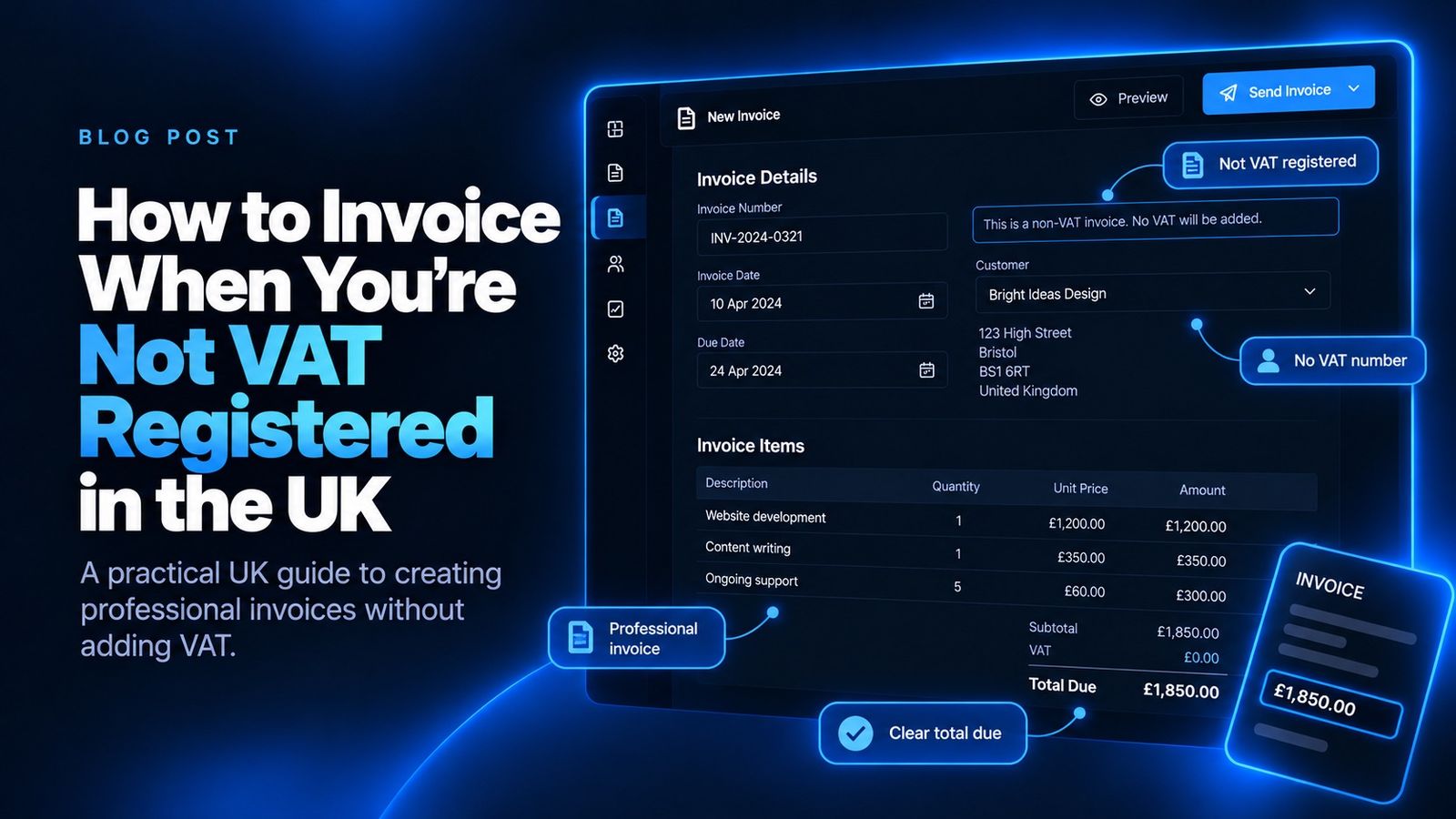
This article provides general business admin information and not financial, tax or accounting advice.
If you have just started freelancing or working for yourself, VAT can make invoicing seem more complicated than it needs to be.
You might be wondering:
Do I need VAT on my invoice?
Should I put VAT at 0%?
Do I need a VAT number?
Can I invoice a VAT-registered company if I'm not VAT registered myself?
The good news is that you can create and send professional invoices without being VAT registered.
If your business is not VAT registered, you normally invoice your customer for the agreed price without adding VAT.
You still need a clear invoice containing the appropriate information about you, your customer, the work and the amount owed. The main difference is that you do not add VAT as though you were a VAT-registered business.
This guide explains how that works for UK freelancers, sole traders and small businesses.
recevo.io helps you create and manage invoices, but every business can have different circumstances. If you are unsure about your VAT position or whether you need to register, check current HMRC guidance or speak to an accountant or tax adviser.
Can you send an invoice if you're not VAT registered?
Yes.
Being VAT registered is not a requirement for running a business or sending ordinary invoices to your customers.
Many freelancers, sole traders and small businesses operate below the VAT registration threshold and invoice their customers without charging VAT.
You might provide:
- graphic design
- consultancy
- photography
- development work
- copywriting
- building or trade services
- tutoring
- marketing
- creative services
- other freelance or professional work
You can still invoice your customers for those services even if you do not have a VAT registration number.
VAT registration affects how VAT is charged and accounted for. It does not prevent a non-VAT-registered business from billing customers.
Do I charge VAT if I'm not VAT registered?
No.
If you are not VAT registered, you should not simply add VAT to an invoice.
HMRC says businesses must register for VAT before they start charging VAT.
For example, suppose you agree to design a website for £1,200.
If you are not VAT registered, your invoice might simply show:
Website design: £1,200
Total due: £1,200
You would not normally turn that into:
Website design: £1,200
VAT at 20%: £240
Total: £1,440
because you are not registered to charge that VAT.
This is different from a VAT-registered business supplying standard-rated services, where VAT may need to be added and shown separately.
Should I put VAT at 0% on my invoice?
Usually, that is not the clearest way to describe the situation.
Being not VAT registered is not the same thing as making a zero-rated VAT supply.
A VAT rate of 0% has a particular meaning within the VAT system. It can apply to certain taxable goods and services supplied by VAT-registered businesses.
If you are simply not registered for VAT, you are not charging your customer VAT in the first place.
So rather than presenting your normal services as:
VAT: 0%
it is generally clearer to create the invoice without a VAT charge.
If you want to make the situation explicit to your client, you can add a short note saying that your business is not VAT registered.
Do I need to write “not VAT registered” on the invoice?
For an ordinary invoice, GOV.UK's general list of required invoice details does not say that a non-VAT-registered business must include the words “not VAT registered”.
However, including a short note can be useful.
For example:
Not VAT registered.
That can make things clearer for a business customer that might otherwise look for a VAT number or wonder why VAT has not been added.
It can be particularly useful when you work mainly with larger businesses whose accounts departments regularly process VAT invoices.
The important thing is not to imply that you are charging VAT when you are not registered to do so.
What should a non-VAT invoice include?
Your invoice should still be a proper business document.
GOV.UK lists information including:
- a unique invoice number
- your business name, address and contact information
- your customer's name and address
- a clear description of what you are charging for
- the date the goods or services were provided
- the invoice date
- the amounts being charged
- VAT where applicable
- the total amount owed
There are also specific requirements depending on whether you operate as a sole trader or limited company.
For example, a straightforward non-VAT invoice might look something like this:
Invoice: INV-0042
Invoice date: 18 October 2026
Due date: 17 November 2026
From:
Taylor Design
Taylor Smith
Your business address
To:
Example Client Ltd
Customer address
Description:
Homepage and landing page design
Amount: £1,250
Total due: £1,250
Payment terms: Payment due within 30 days
Payment reference: INV-0042
You can also add useful information such as a purchase order number, project reference, payment instructions or notes where appropriate.
For a more detailed checklist, see What Should a Freelance Invoice Include?.
Do I need a VAT number on my invoice?
Not if you are not VAT registered.
A VAT registration number is issued when a business is registered for VAT.
You should not invent one, use somebody else's VAT number or add a number that looks like a VAT registration number simply because a client asks for a VAT invoice.
Only VAT-registered businesses can issue VAT invoices.
If you are not registered, send your normal invoice instead.
What if my client asks for a VAT invoice?
This can happen when you work with a larger business.
Their accounts team may routinely ask suppliers for VAT invoices because many of the businesses they deal with are VAT registered.
If you are not VAT registered, explain that clearly.
For example:
Thanks. I'm not currently VAT registered, so VAT has not been charged and I cannot issue a VAT invoice. The attached invoice shows the full amount due.
You do not need to register for VAT simply because one customer happens to be VAT registered.
Whether you need to register depends on your own VAT position and taxable turnover.
Can a VAT-registered company pay an invoice from someone who isn't VAT registered?
Yes.
Your customer being VAT registered does not mean every one of its suppliers must also be VAT registered.
A VAT-registered company can buy goods or services from a non-VAT-registered freelancer or business.
The difference is that there is no VAT charged on your invoice for the customer to reclaim as input VAT.
For example:
You invoice a company £750.
The company pays you £750.
There is no separate £125 of VAT hidden inside that £750 simply because your customer happens to be VAT registered.
This is another reason to keep the invoice clear rather than showing an arbitrary 0% VAT line.
What is the UK VAT registration threshold?
As of October 2026, the VAT registration threshold is £90,000 of taxable turnover.
An important point is that this is turnover, not profit.
It is also not simply a question of checking how much you earned in the last tax year.
HMRC says you must register if:
- your total taxable turnover for the previous 12 months goes over £90,000, or
- you expect your taxable turnover to exceed £90,000 in the next 30 days.
The first test therefore works on a rolling 12-month period.
That matters for a growing freelance business.
Imagine your taxable turnover reaches:
- £78,000 over one 12-month period
- £86,000 a month later
- £91,000 the following month
You should not wait until the end of the tax year before looking at VAT registration.
If your business is growing towards the threshold, monitor your taxable turnover regularly and check the current HMRC rules.
Can I register for VAT before reaching £90,000?
Yes.
HMRC allows businesses below the compulsory registration threshold to register voluntarily.
Whether voluntary VAT registration makes sense for your business is a separate question.
It can depend on things such as:
- who your customers are
- how much VAT you pay on business purchases
- your pricing
- the type of goods or services you supply
- the additional VAT administration involved
That decision is beyond simply formatting an invoice, so it is worth discussing it with an accountant or tax adviser if you are considering voluntary registration.
What happens to my invoices if I become VAT registered?
Once your VAT registration becomes effective, your invoicing requirements change.
VAT-registered businesses may need to issue VAT invoices containing additional information, including their VAT registration number and the relevant VAT details.
That means you should not assume that the invoice format you used while unregistered can simply continue unchanged.
If you are approaching registration, it is worth preparing before your effective registration date so that:
- your VAT number can be included where required
- VAT is calculated appropriately
- your prices and agreements with clients are understood
- your invoice template is ready
- your records are suitable for VAT reporting
If the timing of your registration affects existing quotes, deposits or work already in progress, get advice specific to your circumstances.
Should I add VAT wording to every invoice?
You do not need to turn half the invoice into a VAT disclaimer.
For most non-VAT-registered freelancers, clarity is more useful than complicated wording.
If you want to make your status explicit, a simple note such as:
Not VAT registered
is normally much easier for a client to understand than lengthy tax wording.
The rest of the invoice can concentrate on what actually matters to getting paid:
- who performed the work
- who the customer is
- what was supplied
- how much is owed
- when payment is due
- how the customer can pay
What if I've accidentally charged VAT when I'm not registered?
Do not ignore it.
Charging an amount and describing it as VAT when you are not registered is different from simply making a typo in an invoice description.
If you discover that you have incorrectly shown VAT on an invoice, get appropriate advice on how to correct it.
You may also need to issue corrected documentation to your customer.
Our guide to correcting an invoice after you've sent it explains the general practical process for dealing with invoice mistakes, but VAT-related errors can require specific treatment.
If VAT has actually been charged incorrectly, check with HMRC, an accountant or a tax adviser rather than simply editing the old PDF and carrying on.
Does being non-VAT registered change how a client pays me?
No.
VAT status and payment method are separate questions.
If your invoice says £500 is due, your customer needs a way to pay that £500 regardless of whether you are VAT registered.
You might accept payment through:
- bank transfer
- a card payment link
- another agreed online payment method
With recevo.io, eligible invoices can also be paid online by card after you connect your own Stripe account.
Your customer follows the payment option to Stripe, the money goes into your own Stripe account, and the payment can be recorded against the corresponding invoice in recevo.io.
Your VAT registration status does not determine whether you can give customers a convenient way to pay.
A simple non-VAT invoice checklist
Before sending an invoice when you are not VAT registered, check that:
- the invoice has a unique number
- your business details are correct
- your customer's details are correct
- the invoice date is correct
- the supply date is shown where required
- the goods or services are described clearly
- the agreed amount is correct
- you have not added VAT
- you have not included a VAT registration number you do not have
- any PO or project reference requested by the client is included
- the payment terms are clear
- the customer knows how to pay
If you regularly invoice larger companies, it is also worth checking whether they require a purchase order number before sending the invoice.
Our guide to purchase order numbers on invoices explains how those work.
Frequently asked questions
Can I invoice clients without being VAT registered?
Yes.
You can send ordinary business invoices without being VAT registered. You simply should not charge VAT as though your business were registered.
Should I add 20% VAT if I'm below the VAT threshold?
Not merely because VAT is normally 20% on that type of service.
You need to be registered for VAT before charging VAT.
If you are not VAT registered, do not simply add a 20% VAT charge to your normal invoice.
Should my invoice say “VAT not applicable”?
You do not generally need complicated VAT wording.
If you want to make your position clear, a straightforward “Not VAT registered” note is easier to understand.
Be careful with terminology such as “0% VAT”, “zero-rated” or “VAT exempt”, because those can describe specific VAT treatments and are not simply alternative ways of saying that your business is not VAT registered.
Do I put a VAT number on an invoice if I'm not registered?
No.
If you do not have a VAT registration number, do not put one on your invoice.
Only VAT-registered businesses can issue VAT invoices.
Can I invoice a VAT-registered client?
Yes.
Your customer's VAT status does not require you to be VAT registered yourself.
You invoice the customer for the amount you charge without adding VAT if you are not registered to charge it.
Can my client reclaim VAT from my invoice?
If you have not charged VAT because you are not VAT registered, there is no VAT on your invoice for the customer to reclaim.
Valid VAT invoices are used as evidence when VAT-registered businesses reclaim input VAT.
What is the VAT threshold in the UK in 2026?
The current compulsory VAT registration threshold is £90,000 of taxable turnover (as of Oct 2026).
The rules include both a rolling 12-month test and a test based on whether you expect to exceed the threshold in the next 30 days, so check HMRC guidance rather than treating £90,000 as a simple annual allowance.
Can I voluntarily register for VAT below the threshold?
Yes.
Businesses can choose to register voluntarily even if their taxable turnover is below £90,000.
Whether that is worthwhile depends on your particular business, so consider professional advice before deciding.
Invoicing without VAT doesn't need to be complicated
If you are not VAT registered, creating an invoice is still straightforward.
Create a proper invoice containing your business and customer details, describe the work clearly, show the amount owed, set your payment terms and tell the customer how to pay.
Just do not add VAT or present the document as a VAT invoice when you are not registered to do so.
With recevo.io, you can create professional invoices in your browser, export PDFs, keep customer records, record payments, track expenses and give customers the option to pay eligible invoices online by card through Stripe.
Start here:
No signup. No subscription. No invoice limits. Just private, browser-based invoicing for independent workers.
Unlimited invoices, quotes & expenses · Free forever
Send your next invoice from recevo.io, and every one after it, free
Create the invoice, download a branded PDF or share a secure read-only link, then record the payment when it lands. Free forever, no account needed.
Free forever · No account · No card · No watermark · Opens in a new tab
Unlike most free invoice tools:
- Unlimited invoices and quotes
- Branded PDFs with no watermark
- Works offline in your browser
- Your data never leaves your device
- Expenses and profit tracking included
- No account, no card, no premium tier

“I set up my branding once - now everything I send looks professional.”